Sunday, May 20, 2012

100 APPLES


Black Twig


In 1988 I went to Paw Paw, Michigan to spend the afternoon with my friend Judy Sarkozy while drawing an apple orchard in bloom. The owner of the orchard, Wanda Miller, packed us a perfect lunch to eat in the field. The weather and conversation were exceptional. That day inspired a project that continued for more than 20 years.

It is, perhaps, my own form of taxonomy that prompts me to seek out as many varieties of things as I can find - a sort of visual science. I searched for and drew all of the pansies that I could find in the space of one summer and all of the forms of poppies during another summer. The apples, however, were my longest and deepest search.

It started in a very haphazard way. When I saw a new apple I would buy it and draw it any way I pleased. There was no continuity in how I approached the subject matter or the paper I drew it on - its variety, size or weight. When I finished the drawing it just went to a heap of other apple drawings.

The apple season starts in Michigan in August and the farmers' markets continue to get different varieties into November. The supermarkets often continue to get exotic apples throughout the winter. I kept finding new ones for about 5 years and then got distracted. The pile of apples got put on a closet shelf in my studio. Two years ago I moved my base of operations and found all 73 where I had abandoned them. At that point I knew there was going to be an Herbarium and the collection might be interesting to add to that project. I cut the drawings to the same size and a uniform format for the look of the apple itself was established. Nice drawings that had unsuitable backgrounds or were drawn on smaller sheets were cut out and mounted onto the new, standard size backing.

It seemed right to increase the number of varieties to 100.

The final apple was found by Megan Parry near her home in the southern tier of New York state - a wonderful antique variety called a 20 ounce.  The ceramic snake, pictured on top of drawings, was also made by Megan.
It is tempting to continue drawing new apples but since I have expanded to plums and peaches and pears and potatoes there is plenty to do without looking for the 101st variety.

I am hoping to get started, however, on information about apples. This could take the form of a notebook or printed text and photos on the interleaving between my drawings. The pleasure of this cabinet project is that there will always be something new and interesting to do.


Black Arkansas


Sunday, May 13, 2012

GREEN MEN


"I long for the woods. - The woods! - I often wonder what I am, naturalist or artist, for the pursuit of one hinders the other - I seem always to be deciding which it shall be - Of course it must be an artist, for it [i.e., I] must live, but I am hoping for a day when I can give myself entirely up to Nature."
Charles Burchfield (October 8, 1913)


Since early Roman times human faces have been depicted either made up of leaves or decorated with leaves. Since there is no recorded explanation for this we are left to decide for ourselves what it means. Often vines and leaves are shown growing out of mouths and eye sockets. Some people take this to represent rebirth or renaissance - a sort of cheery interpretation. It seems more likely to me that it is addressing the less comfortable concept of death and the return of the body to nature. In Medieval cathedrals "Green Men" appear regularly in different capacities from charming and decorative to ominous and frightening. They are demons and jolly tricksters. They are always intriguing.

The first green person in my botanical collection is a portrait of my father, Anthony Eugene Eufinger. He appears as a tete de feuilles or foliate head. Such heads are traditionally seen to be either decorated with leaves or peeking out from the woods. I like to think of him as remaining with me even if he is beyond my reach. He is still "in nature", among the leaves. He continues teaching me with the examples he set when he was alive and he is perhaps watching over me as I finish my life.


My own self portrait was inspired by a photograph of an ancient face carved out of rock and covered with moss. I know no details about this image but its serenity has always impressed me deeply. Life can be noisy, filled with work to do, days to manage, people to deal with. I am not complaining as I have work that interests me, a remarkable family and inspiring friends, but the concept of stepping back and blending into nature can also be very tempting.

Wednesday, May 9, 2012

POLLINATORS

Of Wasps:
Although they feed not on raw flesh only and ripe Apples, but upon Pears, Grapes, Flowers, and sundry sorts of fruits; also on the sap of Elms, Sugar, Honey, and almost whatever. They feed on the flesh of Serpents, and then they sting mortally.

T. Muffet, The Theater of Insects (1658)


The drawing hanging above the Herbarium coordinates not only with the face of the cabinet which is devoted to fruit, but also with the drawing hanging over the darker, twin Sky cabinet. Both have a dominant circular feature and phases of the moon. In this case the circle is a plate or charger for a bowl of apricots and the phases of the moon refer to theories of appropriate planting times. A Polyphemus moth is the single representative of an insect group other than wasps.

While bees are covered with hairs that help collect and carry pollen, wasps have relatively slick bodies. Nonetheless, wasps are incidental pollinators for many plants and specialist pollinators for other plants, such as  figs. In addition to pollinating edibles, wasps deserve their place at the table of fruit also because they are essential in their role of keeping in check insects that are harmful. Solitary wasps parasitize a vast variety of insects that are harmful to crops.

A small minority of wasps are aggressive and able to sting.

I chose to depict a table set with fruit and added a variety of wasps because they are so very beautiful - colorful and with such distinctive and interesting body shapes. I have probably done them no service in the long run as people are sometimes bothered by yellow jackets when eating out of doors and this might just bring back memories of bad experiences.

Once, while I tried to cook dinner for biologists working in the field in Idaho hundreds of hornets joined me. I was not stung. They were interested in eating what I was preparing but it was frightening to be surrounded by them. A person who was from the area helped me out by setting up a large bowl of water with a little liquid detergent and two big sausages suspended above. The wasps ate almost half of the sausages but many died in the attempt by landing in the water. I was not happy about their demise but it was a case of self protection and getting dinner on the table.

My grandmother Borchert's beautiful white porcelain cup with the gold rim holds a plum. Her mother's Art Nouveau cocoa cup holds champagne grapes. A ceramic cup by Chris Jackman of Royal Oak, Michigan,  in between the two holds a fig.

Wednesday, May 2, 2012

INSIDE: BOTTOM DOOR

FLOW'ER, n. s.. [fleur, French;  flos, flores, Latin.]
1. The part of the plant that contains the seeds.
If the blossom of the plant be of the most importance, we call it a flower; such are daisies, tulips and carnations.
Samuel Johnson, A Dictionary of the English Language (1755)


The drawing on the inside of the bottom door of the Herbarium honors flowers.  It echoes the feeling of the drawing of vegetables above it, but instead of punctuating the composition with pop art dots there is a shower of white petals from an apple tree drifting down. Another echo is the dark central feature.  This time it is a solitary black/purple parrot tulip. 
This year the weather was mystifying.   Early spring flowers began to bloom during a very warm March and continued to bloom for an extended period when the weather cooled off just enough to maintain them.  New plants kept blossoming while the early ones remained.  It is the first year I can remember the forsythia and the dogwood blooming together.   The world has been a fairyland of pink and white and yellow.
It may be beauty with a price as there is talk of no buds on the grape vines in the western part of the state.  The cherry crop always seems to be on the edge of disaster so that would be nothing too new.  I have not seen many pollinators out there doing their work. On the other hand, Larry, the egg man at the Eastern Market, says there was not a deep enough freeze this year to kill many of the harmful insects sleeping in the soil.
Who knows at this point whether my drawing, which has no respect for seasons, might turn out to be a bouquet that could actually be picked in one day? Everything pictured is from last year's garden which bloomed in a more normal progression.  

Thursday, March 15, 2012

INSIDE: TOP DOOR

VEGETABLE, n.s. [vegtabilis, school Lat, vegetabile, Fr.]
Anything that has grown without sensations, as plants.

Other animated substances are called vegetables, which have within themselves the principle of another sort of life and growth, and of various productions of leaves, flowers and fruit, such as we see in plants, herbs, trees. Watts

Samuel Johnson, A Dictionary of the English Language (1755)


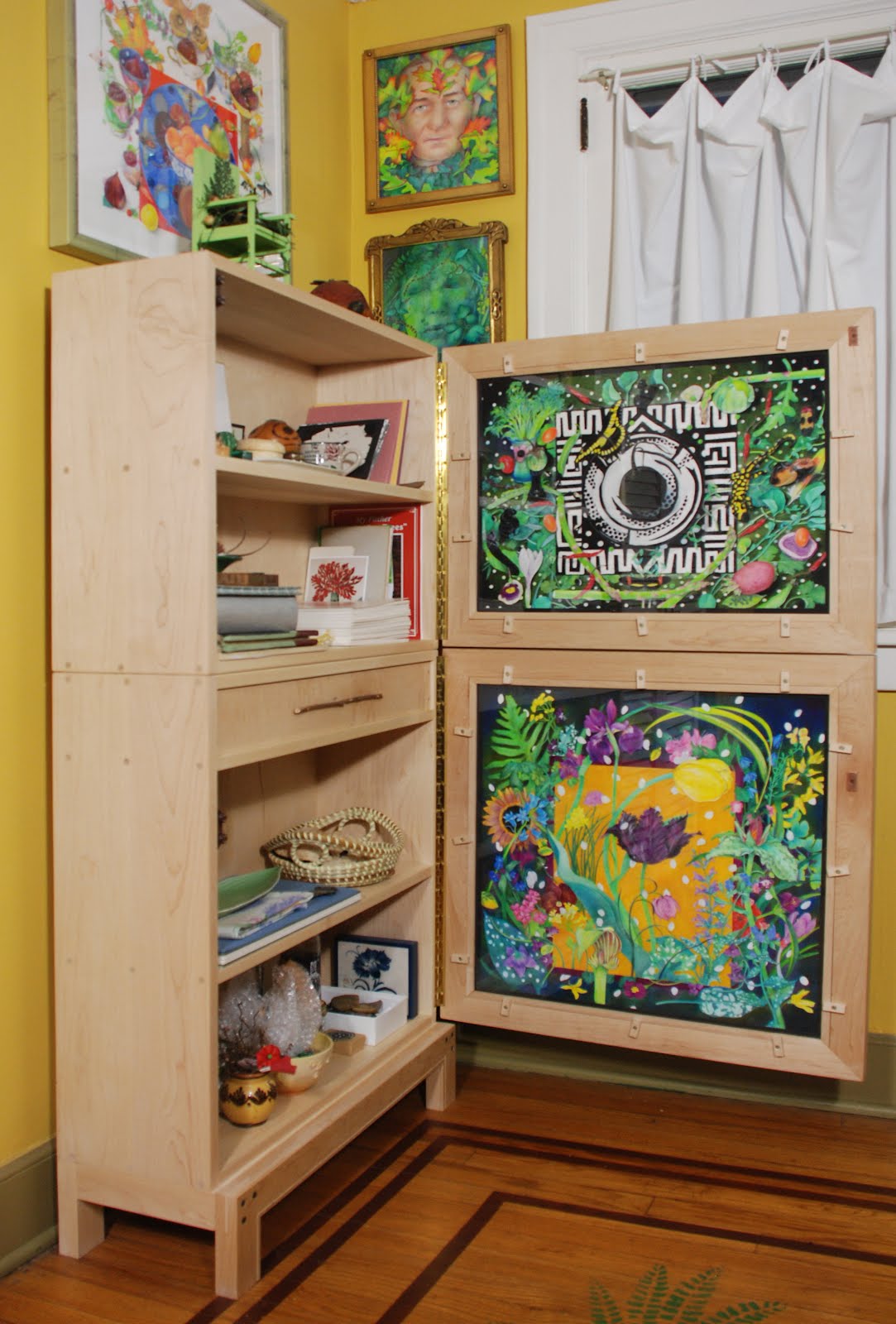
The exterior of the Herbarium is devoted to fruit. The inside drawings feature vegetables behind the top door and flowers behind the bottom door.


VEGETABLES

To choose a black radish as the centerpiece for the visual statement representing vegetables is a bit on the strange side. One expects color, not the absence of it. I found it irresistible. This object came to me as a gift from Megan Parry who found a farmer at the Eastern Market in Detroit who specializes in radishes. His table is somewhat spare but what is there is pretty amazing - huge white and black radishes!

The title for this drawing is "Midnight Snack" and the concept is a place setting for a vegetarian. The radish sits on a plate designed by the Pop artist Roy Lichtenstein. The plate sits on a piece of black paper decorated with white wax dots. Beneath is a geometric patterned mola from Panama. Further table decorations include three black chess pieces, a tiger salamander, a
Heliconius butterfly, a Paplio cresphontes butterfly, a white crocus, feathers and a Buprestid beetle.

The rest of the food is scattered about: a slice of a purple potato, an assortment of peppers, asparagus, a tomatillo, gold pearl tomatoes, peas, greens, a round zucchini, rapini, beans, a red potato.....delicious.

Thursday, January 19, 2012

OUTSIDE: LOWER DOOR


FRUIT, n. s. [fructus, Latin; frwys, Welsh; fruit, French.]
1. The product of a tree or plant in which seeds are contained.

The strawberry grows underneath the nettle,
And wholesome berries thrive and ripen best,
Neighbor'd by fruit of baser quality. Shakesp. Henry V.

2. That part of the plant that is taken for food.

See how the rising fruits the garden crown,
Imbibe the sun, and make his light their own. Blackmore

Samuel Johnson, A Dictionary of the English Language (1755)


Opening a papaya: the contrast between the beautiful colored flesh of the fruit and the black mass of seeds is startling.

All fruit is best eaten in season and close to where it was grown.
Our son and daughter-in-law were married in Calcutta. A second reception was given in Jargram by her parents a few days later. The afternoon before the big party we relaxed in warm, December sunlight in their yard which was filled with fruit trees that would never survive in Michigan. A papaya was harvested, pared and served - nothing like the ones I thought I had enjoyed from our supermarket. It will remain in my mind as one of my ultimate eating experiences.


The meadowlark (Sturnella magna) eats seeds, insects and worms so the fruits it stands with are probably pretty safe - a peaceable kingdom. The plants involved in the drawing span the seasons from early spring violets and a Siberian iris, to early summer Queen Anne cherries and the beneficial blueberries that are harvested here in August.


In this drawing of a peach all the elements echo some aspect of each of the others.

The ovary walls of the flowers in the genus Prunus harden or lignify, creating their distinctive stones or pits which protect the seed inside. The peach has such a pit hidden inside it. The striated skin of this species has some of the aspects of the linear quality of the paper it is sitting on. The piece of paper is unique in that I made it in an experiment many years ago but it is traditional in employing one of the four classic patterns used in marbling - the stone design. The actual stones placed on the paper are from my collection of ringed rocks. They echo both the shapes and the linear aspects of the paper.


There are many kinds of china that are not just decorated with fruits and flowers but replicate shapes - for instance, cabbages that are soup tureens. In an antique shop in Shakespeare, Ontario I once saw a set of incredible cups in the shape of tulips. They were frighteningly expensive and certainly worth it but well beyond what I would ever have been able to justify spending. I still dream about them.

I have taken the idea a step closer to nature. Here a brilliant oriental poppy pretends to be a bowl containing a serving of raspberries. Currants are scattered around the table that the poppy sits on. An edible landscape.

Friday, September 2, 2011

HERBARIUM

"The tree which moves some to tears of joy is in the eyes of others only a green thing that stands in the way. Some see Nature all ridicule and deformity, and some scarce see Nature at all. But to the eyes of the man of imagination, Nature is imagination itself."

William Blake, 1799, The Letters


An HERBARIUM, sometimes described as a museum of plants, is composed of plants collected, pressed, dried and organized for study and record keeping. My concept of an herbarium expands this idea to include drawings, books and objects that deal with botanical matters.
The cabinet for my Herbarium was built by Oscar Hoff. The wood is maple and the design echos the Sky cabinet.

The exterior of the cabinet is faced with drawings of fruit. Featured in this post are the eleven drawings on the top door.


FIGS: Despite the fact that fresh figs seem more available now than in the past, they retain a feeling of the exotic. Certainly the beautiful and complex interior is a surprise the first time one sees it revealed. They are among my favorite things too eat and to draw. They stand at the top of the cabinet, center stage, in a proud line.


PLUOT: Whereas the fig is notable for its antiquity, the pluot is a very modern fruit. It dates from 1989 and has an inventor, Floyd Zaiger. 70% plum and 30% apricot it is sweet and some varieties have an interesting dappled skin. My Dapple Dandy is sitting on a tile made by the Trent Tile Company of Trenton New Jersey before 1939.


LEMON: On a very hot day in Athens many years ago, after a thrilling wander around the Acropolis, I bought a glass of fresh unsweetened lemon juice from a well placed stand outside the Propylaea. I believe it was the most refreshing and delicious beverage I have ever tasted. The lemon is an amazingly useful fruit that can appear on any part of a menu.
The drawing references the importance of pollinators to the production of fruit. A bumble bee rests on the lemon and underneath is a Chinese plate with the pattern called 10,000 butterflies.


GRAPES: Our son, Arno, loves grapes most of all when they become raisins. His intake can be so impressive that when he was visiting cousin Gladyce in Santa Monica, California, she took to rationing him to one bowl a day, hiding the rest of her supply. When he returned from India for the first time he brought many varieties of raisins home for a "tasting" event. Some families celebrate with a nice bottle of wine. We get out the raisins.
The black grapes in the drawing are coupled with a beautiful maple leaf found on the day of purchase.


CHERRIES: Now that there are only short gaps in the availability of fruits and vegetables, cherries remain a brief luxury. Here in Michigan they arrive at the farmers' markets looking like baskets of jewels. Probably due to fragility, sour red cherries are rarely seen in the supermarkets. Or, perhaps, people are less willing than my husband to pit them with an eye to a beautiful pie.
Four of the rare cherries rest on a piece of Indian textile.


BLUEBERRIES: Warned against potential poisons, I was once reluctant to eat anything growing wild with the exception of blueberries. On Deer Isle in Maine I found enough of the tiny berries to make a pie using a recipe from the New York Times that included sour cream. The woman from whom we were renting a room asked me for the recipe. It may have been my greatest compliment as a cook.
As an artist I have used blueberries as dark, dusky blue punctuation marks in my drawings. Here on the cabinet they fill a ceramic cup which is covered with pop art comic book dots designed by Roy Lichtenstein and produced by the Durable Dish Company.


PEAR: The pear may be the most difficult fruit to get right. It seems to go from being hard to being over ripe in a matter of minutes. A perfect pear is rare and a true joy.
This pear is a Bartlett, a standard pear found in the supermarket. The wings that make it look capable of flight are those of a butterfly, Pieridae Pheobis philea. The moth in front is an Arctiidae.


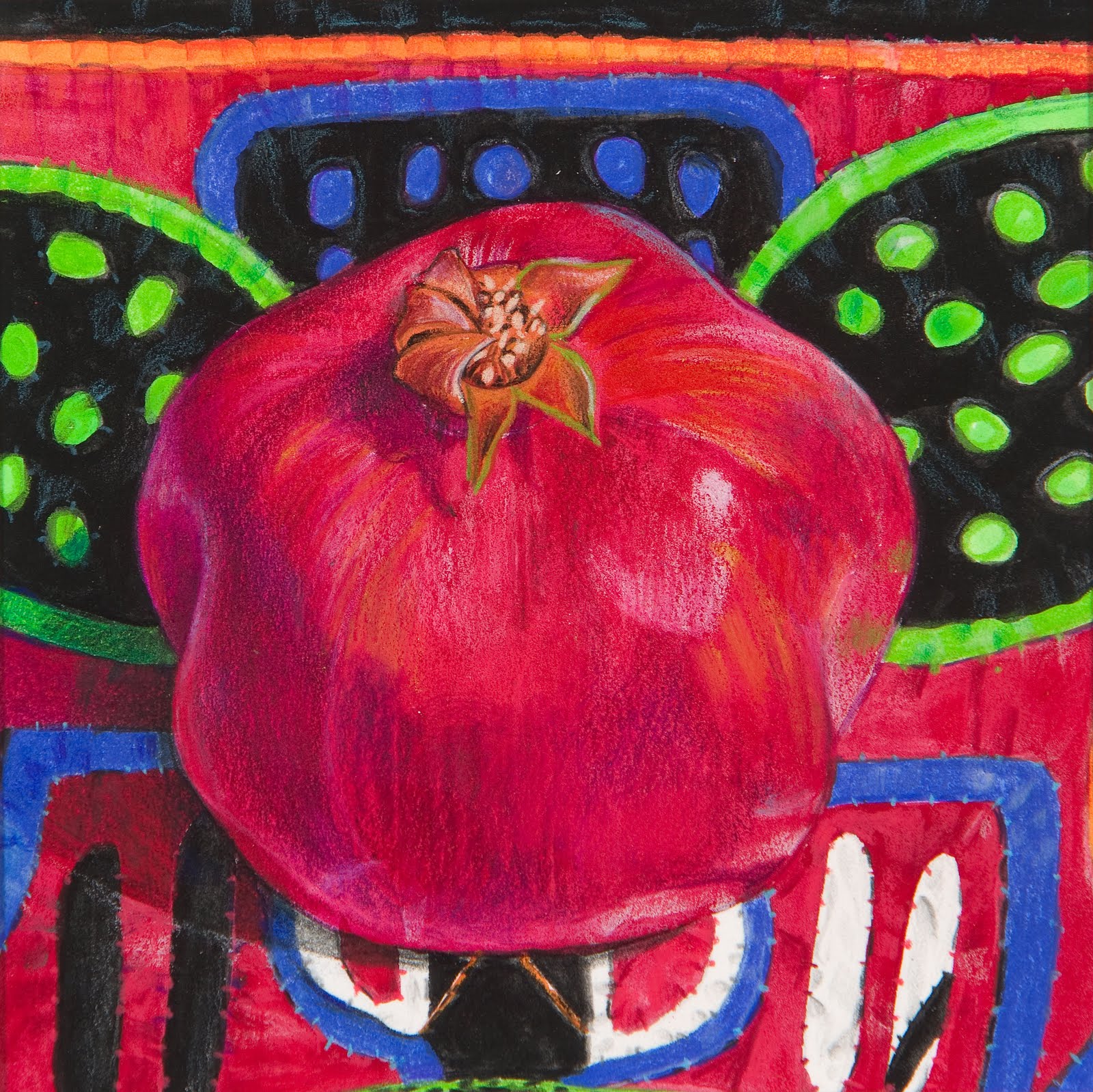
POMEGRANATE: When I was still not a student in the art school at the University of Michigan I signed up for a design class. The first project required us to choose a fruit or vegetable and use it in as many ways as we could think of: line drawings, watercolors, abstractions using color patterns on the skin, cross sections that were printed, etc. I chose the pomegranate which seemed a very exotic fruit at the time. I loved the project so much it was one of the reasons that I switched my major from English to art.
This pomegranate sits on a mola from Panama that depicts a fly.


PLUM: Wrapping or containing things in a surprising way has always appealed to me. Here a black tulip acts as a cup which holds a black plum. The plum is hiding in plain sight.
There are so many wonderful ways to use plums but my favorite remains my grandmother's plum kuchen. When I bake the cake I can always feel her presence in my kitchen.


CRAB APPLE: Crab apples, often called "wild apples", are small, very sour and woody. As food for humans they are not very appealing except in their pickled form or turned into jelly. However, as ornamental trees they are dearly loved for their blossoms in spring and their fall crop of elegant looking fruit.
This specimen was harvested from a tree in our neighborhood. It sits on top of a stack of objects beginning at the bottom with leaves from a choke cherry tree, a tile sample and a small piece of rusted iron of unknown origin.


APPLE: Recent information no longer supports the idea that the modern apple had crab apple ancestors. There is evidence that it was a separate branch of the family which began in the Illi Valley in China and Kazakhstan, whose capital, Almaty, translates as "father of apples". I was delighted to learn that alma, my grandmother's name, is Hungarian for apple.
There are now thousands of species of apple. The one featured on the cabinet is a Gala which is backed by a design from the Grammar of Ornament and comes from the pages devoted to the Middle Ages.